The way we manage critical infrastructure is evolving.
Digital twin technology is transforming asset management, giving engineers, asset owners, and contractors real-time insights into the condition of critical structures.
But what exactly is a digital twin, and how can it drive efficiency, reduce risk, and improve decision-making?
What is a Digital Twin?
A digital twin is a virtual representation of a physical asset, system, or environment, generated using data to mirror its real-world counterpart.
The rise of digital twin technology has allowed stakeholders to monitor, analyse, and optimise performance of critical infrastructure, without needing to set foot on-site.
Different types of digital twin include:
- Component Twin: A single component, such as a motor or sensor
- Asset Twin: A complete structure like a bridge or a building
- Process Twin: An end-to-end workflow, such as a supply chain
- System Twin: A network of assets, like a railway system or power grid
- Urban/Infrastructure Twin: A large-scale model of an entire city
- Hybrid Twin: A combination of multiple digital twin types
.png)
3D Reality Twins for infrastructure
Trendspek's 3D Reality Twins are purpose-built for infrastructure, providing sub-centimetre detail of assets at a specific point in time.
Covering hard-to-reach or restricted areas, these highly-detailed visual representations can be zoomed into, orbited around and interacted with to detect flaking paint or even the smallest hairline crack.
This level of detail is ideal for visual inspections, regulatory reporting, and lifecycle management, making it particularly valuable for those responsible for maintenance, safety, and compliance.
3D Reality Twins are created by stitching 1000s of data points, captured by drones, cameras, or other photogrammetry methods, into interactive 3D replicas with exact spatial context, such as measurements, height, distance, slope and volume.
Trendspek’s 3D Reality Twins can be used for a wide range of industry sectors and use cases, from underneath shipping wharves to over large reservoirs.
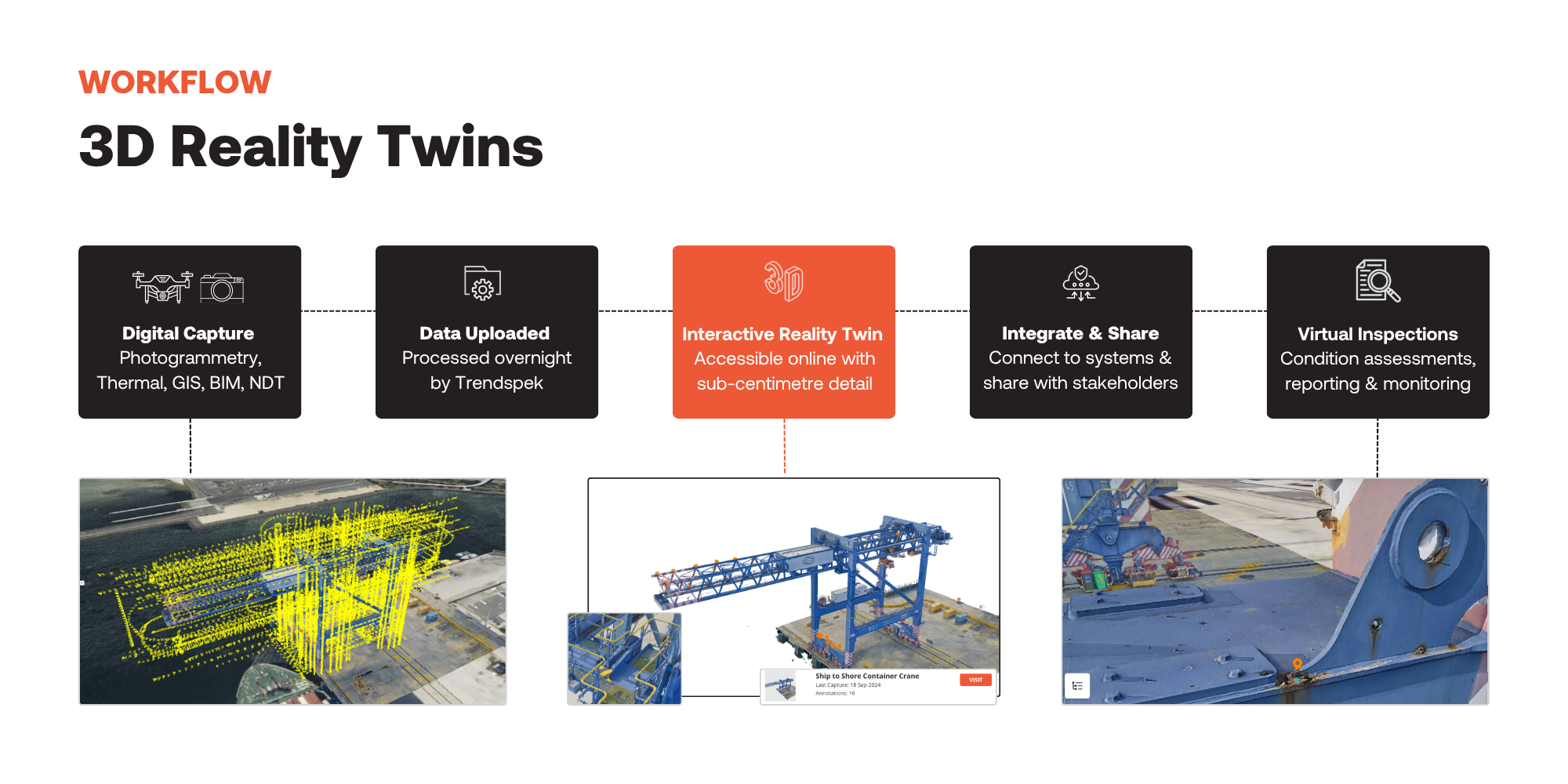
3D Reality Twins can enable
- 90% more coverage when compared to traditional inspection (ropes, EWPs), including hard-to-reach or restricted areas.
- Detection of fine details, such as hairline cracks, deformations, or concrete corrosion before they become critical.
- Reduced risks, with remote inspections eliminating the need for costly scaffolding/cranes or and putting personnel on site in hazardous areas.
- Change detection over time. Repeated captures and updated 3D Reality Twins can be layered and compared interactively, allowing asset managers to track deterioration and prioritise maintenance over time.
- Operational efficiency, enabling teams to plan maintenance without unnecessary downtime.
- Improved regulatory compliance, with precise documentation of asset conditions with exact measurements, locations, specifications and materials.

Use cases in infrastructure
Read some of our case studies with industry leaders around the world, who have used 3D Reality Twins to achieve efficiency gains in their sector.
Osprey Integrity: Minimising turnarounds for large industrial facilities
"We are able to iterate and re-iterate, and as a result, the maintenance departments are starting to get ahead, asset integrity is more thoroughly informed, and safety risks are identified and addressed in a more timely manner."
University of Sydney: 100+ buildings captured across campus
"It gave us the ability to capture change over time really comprehensively. We now have documented evidence of the whole fabric of the assets, and more data, and better geolocated data, so we can make more informed decisions to reduce future risk.”
White Bay Power Station: Remediation works ahead of Sydney Biennale
“There were many hard-to-reach areas that required repair and certain locations that were physically inaccessible. Using drones and Trendspek minimised the need to bring in mobile plant equipment and mitigated the associated risks.”
NSW Ports: Accessing hard-to-reach areas across 24/7 shipping ports
"It can take a lot of work to organise a site inspection – you need all the variables to line up. Now, we can give them the 3D model and they can start looking at it and getting their head around the project earlier. This saves a lot of time.”
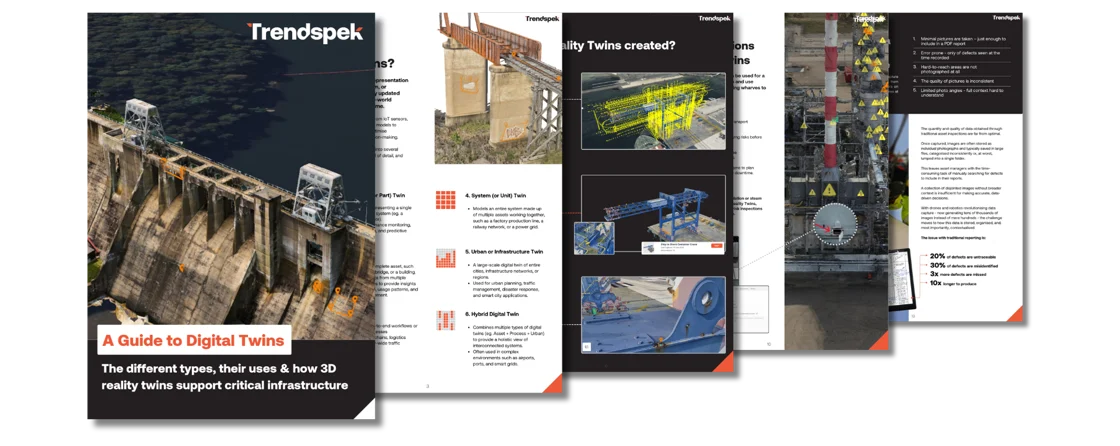
Learn more in the free resource paper
Want to dive deeper? Our resource paper “A Guide to Digital Twins” explores how asset owners and engineers are using digital twin technology to transform infrastructure management.