Across asset management, the pressure on infrastructure is mounting. Complex structures are ageing, maintenance budgets are tightening, and many asset owners still operate reactively, responding to issues only once they become urgent - or known.
Kevin Williams, Associate Asset Manager at Beca, is navigating this transition firsthand.
“It’s around cost and risk,” he says. “A lot of assets are ageing, and there hasn’t been proactive spend. There’s going to be a bow wave of things that need sorting out.”
In a recent conversation with Trendspek, Kevin shares how his team at Beca is embedding a digital, 3D-led workflow into their service delivery within the transport asset management team.
The move beyond static reports
One of the most common barriers Kevin sees is surprisingly basic.
“Some clients don’t fully understand what assets they’ve even got, let alone the true condition of them.”
Traditionally, inspection results are delivered as PDFs with defects documented and relevant photos attached. But the context is often limited. A crack might be visible in an image, but its exact location on the structure is not always obvious.
Kevin’s team wanted a better way to visualise assets and communicate condition clearly to clients.
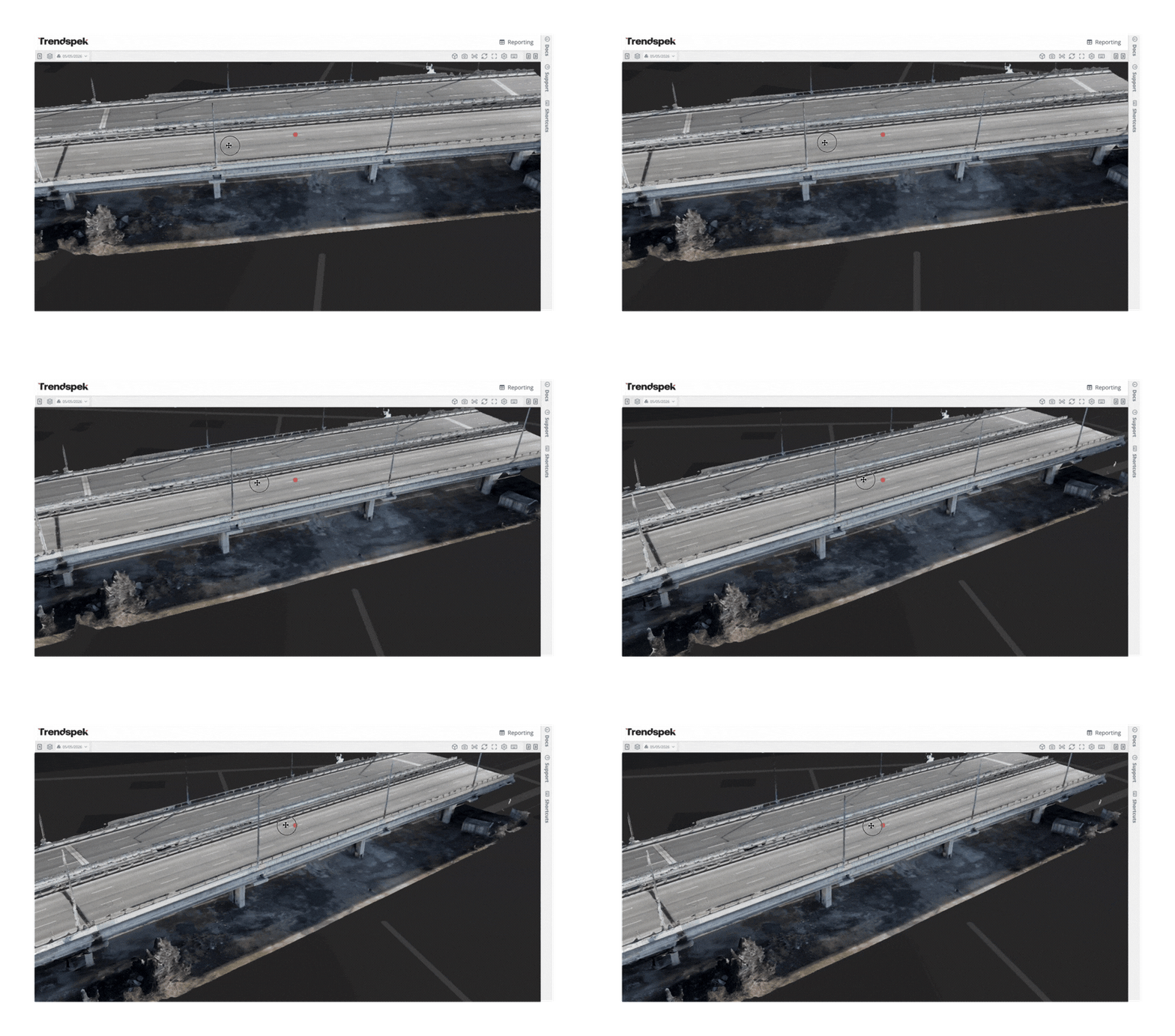
By anchoring inspection data to a navigable 3D model, Kevin and his team can now show clients exactly where defects sit on a structure, measure their extent, and revisit them over time. The conversation shifts from describing issues to demonstrating them.
"Being able to move around the model and look around is key. Without that, it's just really hard to explain what we're looking at."
This shift has supported how the team advises clients. Decisions are no longer based on isolated photos or subjective interpretation, but grounded in a visual record that can be reviewed and questioned by multiple stakeholders.
.gif)
Reducing risk before anyone goes on ropes
For complex bridges, traditional inspections often require rope access teams, long site presence, and a high exposure to safety risks. When Kevin trialled a digital approach on one of their routine bridge inspections, the results were difficult to ignore.
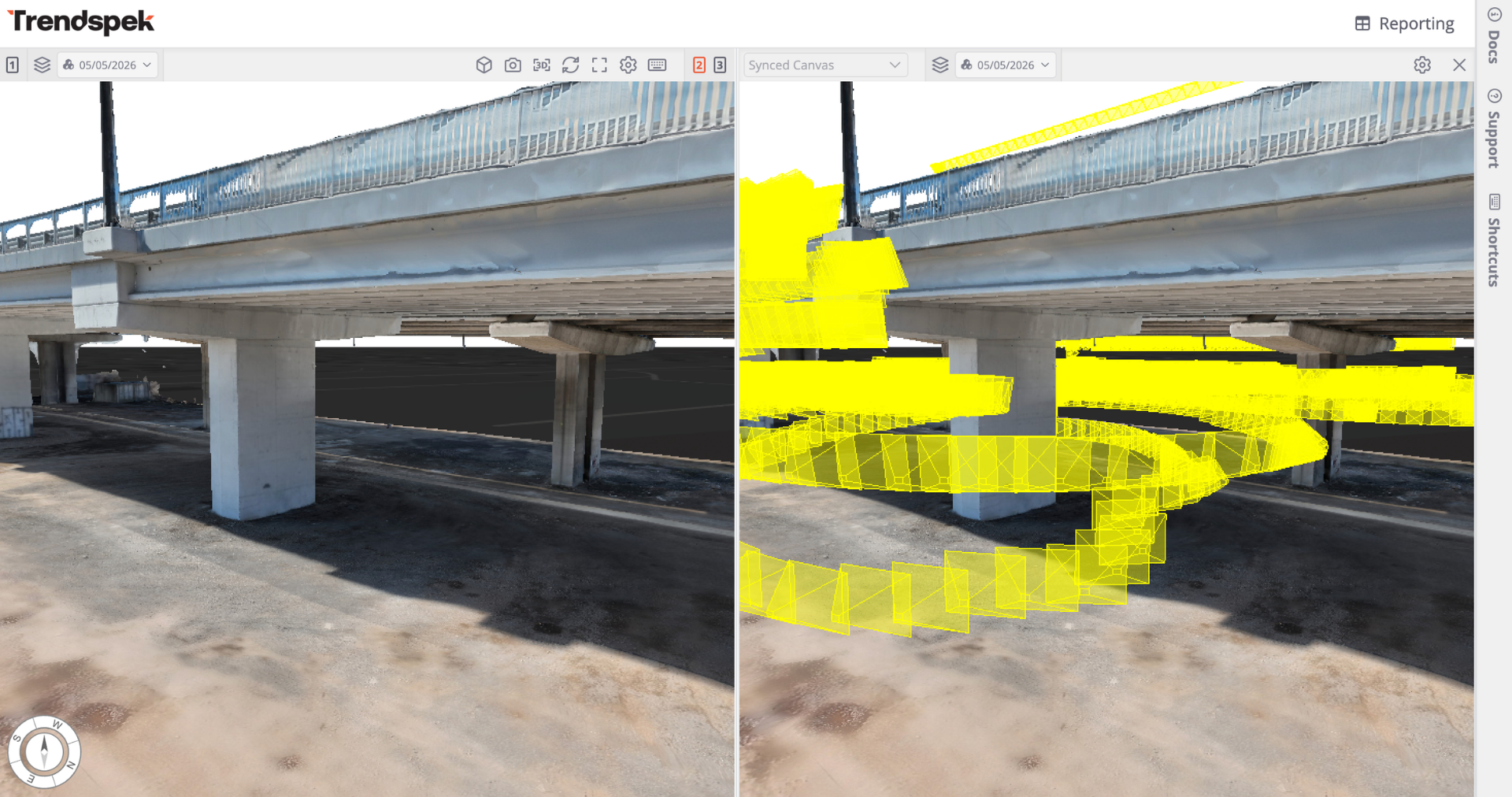
A conventional rope access inspection would typically involve at least five people and could take close to a month, staged around road closures and access constraints. Using in-house drone capture and Trendspek, the team completed the modelling in roughly nine days with just two people on site.
The results went beyond efficiency. The 3D model enabled inspection on parts of the bridge not normally accessible, revealing defects that had not previously been identified.
“Essentially, without having that model, we wouldn’t have found these things.”
Those discoveries triggered targeted follow-up inspections in areas where close-up testing was required. Instead of broad, reactive maintenance, the team could direct effort precisely where it was needed.
Giving clients clearer control over repair scope
One of the most significant impacts has been on repair governance. In traditional workflows, contractors often assess defects using PDF reports or on-site, and define the repair scope themselves. Kevin shares that it’s not uncommon for contractors to expand on scope once work begins, and without a single source of truth, it can be difficult for asset owners to challenge that scope.
"It keeps the contractor under control. Because you can isolate areas in terms of what needs fixing, they can't over-exaggerate. It helps the client keep repair costs under control."
Measuring defects directly within the 3D model, Kevin’s team has been defining repair scopes before contractors even mobilise.
“It keeps the contractor under control,” Kevin explains. “Because you can isolate areas [in Trendspek] in terms of what needs fixing, they can’t over-exaggerate. It helps the client keep repair costs under control.”
Why UX and customisation matters for engineering teams
For Kevin, the difference wasn’t just the 3D visualisation, but how quickly they could customise defect coding, tag issues, and produce a usable model, without weeks of training.
Kevin’s team is no stranger to digital tools, but previous attempts with other software often hit a wall of complexity. He explains that other products were often too clunky and made it difficult to tag defects.
"Trendspek was easy to set up: the templates, fields, and coding of defects," Kevin explains. "It was more customisable and quicker than some of the others. Our engineer had never used it before, had one training session, and was able to customise it for what we needed."
Building continuity across inspection cycles
Bridges are inspected on cyclic intervals, often every six years. Historically, comparing condition between cycles relies on written descriptions and a handful of images in a PDF report. By recapturing and layering inspection data on the model, the team can now compare defects over time within the same spatial context.
“You can turn those layers on and off, so the trend monitoring over time is really valuable.”
This continuity means Kevin can show his clients progression clearly. Instead of a stack of disconnected reports, clients build a visual history of their asset.
That makes it easier to:
- track deterioration over time
- validate remediation works
- prioritise future maintenance
- defend capital decisions using consistent evidence
Rethinking how inspection results are delivered
As these workflows mature, Kevin believes the role of the traditional inspection report may start to shift as well.
“Do the clients really need a report? It’s in the model. I think that’s where it will go next.”
Since trialling the workflow, Kevin has shared the approach internally across other disciplines and presented the concept to transport agencies exploring digital inspection pathways.
For him, the biggest change isn’t necessarily the technology itself, but what happens when engineers, contractors, and asset owners can all work from the same inspection record.
“The visual aspect is the big game changer,” he says. “It just makes it easier for engineers and clients to understand what they’re actually looking at.”
"Do the clients really need a report? It's in the model. I think that's where it will go next."
Instead of inspection evidence disappearing into disconnected folders and static reports, the inspection becomes part of a longer-term operational record that can support how infrastructure is maintained, prioritised, and funded over time.