When the market grows uncertain, asset owners may instinctively pull back. However, conversations with leading REITs across industrial, commercial, and retail sectors reveal a consistent and more dangerous theme — waiting for something to go wrong. Trendspek CEO Derek Feebrey writes.
.jpeg)
Over the past few months, I’ve spoken with several leading Real Estate Investment Trusts across industrial, commercial and retail portfolios.
A consistent theme has emerged: The current way of managing building condition, inspections and capital works isn’t just inefficient – it’s risky, costly and outdated.
And now, it's vulnerable.
The recent global share martket plunge, triggered by newly-announced US tariffs, has rattled investor confidence and sent a clear message to asset managers across sectors: The margin for error is shrinking. Fast.
When markets get shaky, the instinct is to pull back. Delay projects. Defer decisions. Pause spending.
But here’s what I’m seeing from the most strategic REITs right now:
- They’re not spending more. They’re spending smarter.
- They’re not guessing. They’re planning based on real, quantifiable risk.
- They’re not reacting. They’re using data to stay ahead of surprises.
How did we get here? The growing challenges for REITs
In the past few months, I've worked with REITs facing 36+ challenges across operations, safety and capital works.
Common threats, that come up again and again include:
- Asset data is scattered or sitting in people’s heads
- Safety risks from rope access, BMUs and roof inspections
- Incomplete or inconsistent inspection reports
- Surprise remediation costs and budget blowouts
- Difficulties verifying contractor quotes
- Friction between internal teams and external service providers
And most recently, and the most concerning of all:
Some Tier 1 engineering firms are refusing inspections altogether due to rising liability risks – especially after recent fatalities.
In stable markets, these issues are costly. In volatile markets, these issues are dangerous.
A look at the common risks by percentages
When performing risk audits for our clients, some recurring themes have come up.
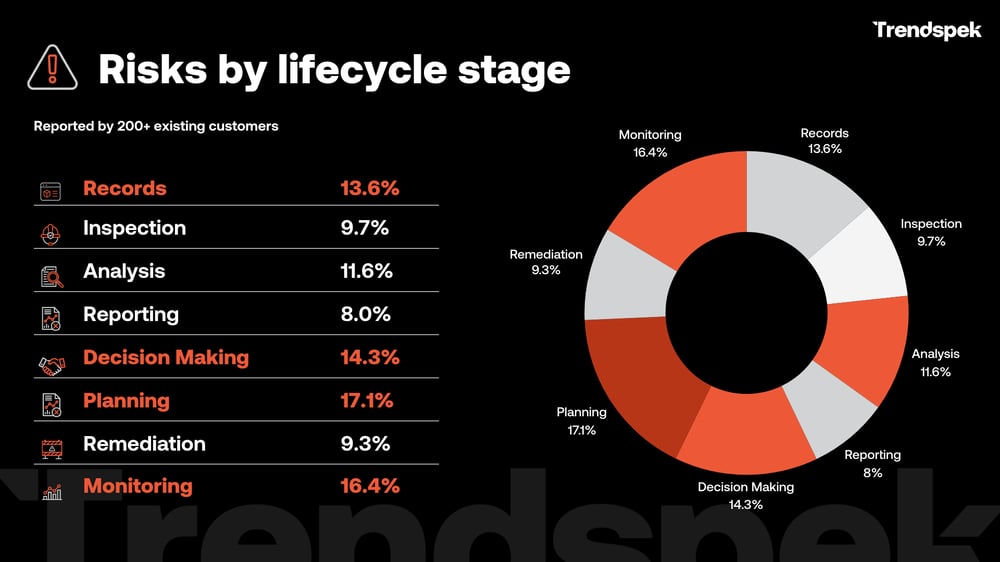
The scores from these risk audits have consistently highlughted the following top four areas of risk: Planning (17.1%), Monitoring (16.4%), Decision Making (14.3%) and Record-Keeping (13.6%)
Primary Risks for Real Estate Investment Trusts

Planning — 17.1% of Total Risk
The Problem: Scattered PDFs. Walkarounds. Endless emails. Contractors quoting from guesstimates.
The Fallout: Overblown contingencies. Sky-high quotes. Re-inspections galore. Chaos before you even start.
How do you plan when the data is buried in inboxes?

Monitoring — 16.4% of Total Risk
The Problem: Files everywhere. Reports no one trusts. Spot checks pretending to be a system.
The Fallout: Risks stay hidden. Costs blow out. Your first clue? When something breaks.
If you can't see it in real-time, you're already too late.

Decision Making — 14.3% of Total Risk
The Problem: Capital decisions made on assumptions, not evidence.
The Fallout: The wrong asset gets the spend. Risk goes unmanaged. The board asks questions you can't answer.
You don't need more reports. You need the right system.

Record-Keeping — 13.6% of Total Risk
The Problem: PDFs. Spreadsheets. Local knowledge that leaves when people do.
The Fallout: Missing info. Costly repeat inspections. Weeks wasted finding what should take seconds.
If your records don’t move at the speed of your portfolio, you’re losing.
If we look further at the breakdown, we can also apply the percentage of severity by Asset Lifecycle Stage and Potential Consequence.
As we can see from the charts below, leading REITs are also reporting that Inspections, Remediation and Analysis done through traditional means can carry more than 9% of risk.
When we compare these risk scores against the potential consequence, the percentages become a lot more serious.
If left unaddressed, some of these issues can result in staggering numbers:
- 38.3% Financial Risk
- 18.1% Governance & Legal Risk
- 16.6% People (Safety) Risk
So, what are the leading REITs doing differently?
The innovators within Real Estate are not just adopting digital tools. They’re thinking bigger – and going systemic.
These REITs are moving towards Structural Lifecycle Management Systems like Trendspek. A smarter, portfolio-wide approach that gives full visibility over the condition, risk and value of every asset.
What that actually means in practice:
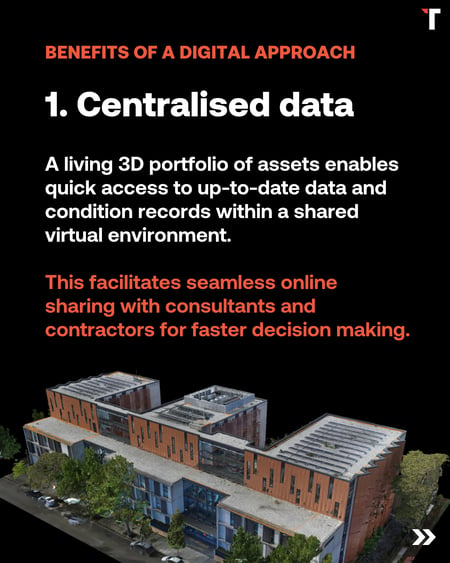
- Reliable, centralised asset records within a digital system or database
- Safer, more accurate inspections
- Capital works based on real-world condition, not guesswork
- Live collaboration between internal teams, consultants and contractors
The reality? The most successful REITs haven’t increased their budgets. They’ve just started spending them smarter.

Where the ROI of this approach becomes very real
By shifting from reactive inspections and fragmented software to a connected Structural Lifecycle Management System, they’re making decisions based on evidence – not assumptions.
The real estate investment trusts that have made the shift to embrace technology and digital workflows are seeing:
- Quotes are scoped properly without extra site visits or inflated provisional sums
- Variation costs and rework drop dramatically – often 3 to 5 times less
- Faster tendering cycles, fewer surprises and better cost control
- Better long-term planning, backed by consistent asset condition data
Here's some of the numbers, and outcomes, that we have reported with leading REITs.

Portfolio Risk - Down By 68%
Complete inspections 50% faster and streamline critical information within a secure, single source of truth.
Protect revenue and reduce surprise variations, delivering a 68% reduction in overall portfolio risk including:
- Financial (64%)
- Governance & Legal (66%)
- People & Safety (77%)
- Reputation (69%)

Contractor Costs - Down By 43%
Up to 43% reduction in contractor costs.
Virtually share accurate specs, measurements and condition insights and minimise repeat site visits, or the back-and-forth.
Return on Investment - Up By 13-16x
Track defects, trends and deterioration over time digitally.
Allocate resources efficiently and prevent costly emergency repairs.
Efficiency - Up By 77%
Up to 77% improvement in internal labour efficiency.
Leverage accurate digital records to bring teams up-to-speed.
The biggest impact? Capital works and time saved.
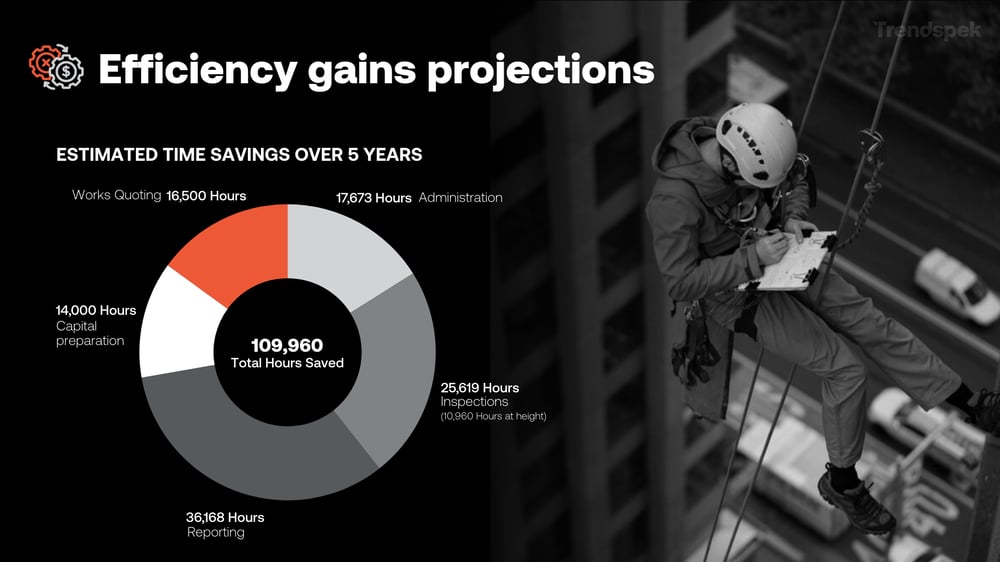
Over a 5-year period, let's take a look at the estimated projections below (based on a portfolio of 200 mixed buildings in Commercial, Industrial, Retail).
Estimated Cost Savings (over 5 years):
- Capital Works savings: $57,560,000.00 AUD
- Inspection Cost Savings: $11,738,160.00 AUD
Estimated Time Savings (over 5 years):
- Total hours saved: 109,960 hours
- Reporting Hours Saved: 36,168 hours
- Inspection Hours Saved: 25,619 hours (10,960 hours worked at heights)
The real risk isn't the market. It's waiting for something to go wrong.
It’s not just the next inspection or repair job.
It’s when your board or investors ask why you're still using outdated methods – while your competitors are using live data to reduce costs, de-risk portfolios and get ahead.
Before another dollar goes into reactive maintenance or a partial inspection, ask yourself:
"How much are we overspending by not changing the approach?"
With up to 70% risk reduction and proven double-digit ROI, this isn’t just a smart move – it’s a strategic one.

Derek Feebrey is the Chief Executive Officer of Trendspek, a leading digital asset management solution that is revolutionising the $24billion asset industry. Together with co-founders Fiona Church and Mitch Deam, Trendspek is empowering asset owners and insurance companies with the ability to virtually inspect and monitor large-scale infrastructure safely, securely and remotely — all without leaving their desk.